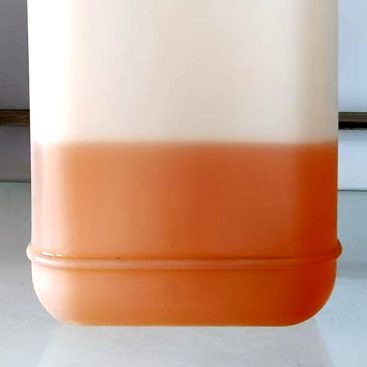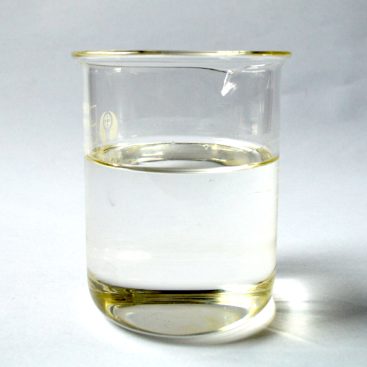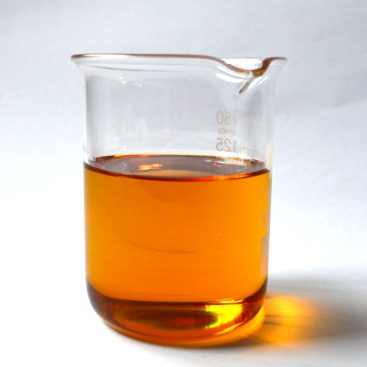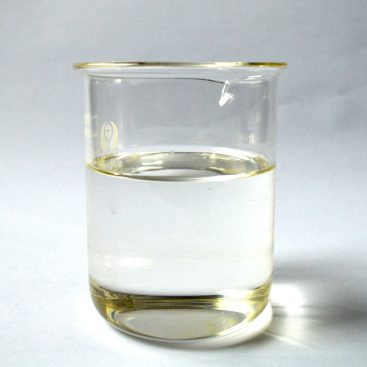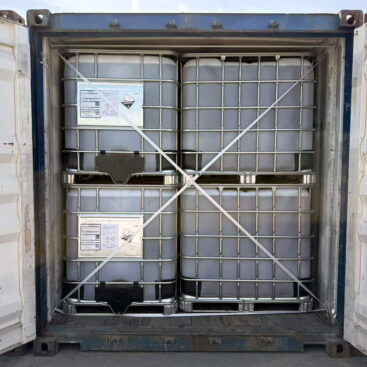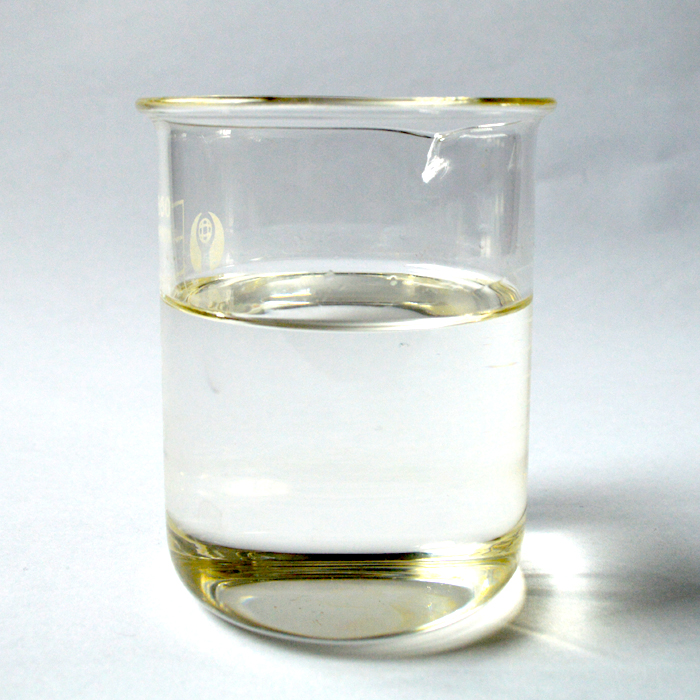
Bis(2,4,4-triméthylpentyle)l'acide phosphinique est un composé organophosphoré ayant des applications importantes dans la recherche et l'industrie, en particulier comme extractant et ligand.
Voici un aperçu complet de ses principales spécifications:
CAS: 83411-71-6
N° CE: 280-445-7
Formule: C16H35O2P
Môle. poids.: 290.42
Concentration: ≥94 %
Numéro ONU: 3082
Classe de danger pour le transport: 9
Groupe d'emballage: III
📋 Informations générales
Numéro CAS: Il existe deux numéros CAS associés à cette substance dans la littérature: 83411-71-6 et 27661-42-3.
Formule moléculaire: C₁₆H₃₅O₂P
Poids moléculaire: 290.42 g/mole
Synonymes: Acide diisooctylphosphinique, Cyanex 272, Ionquête 290.
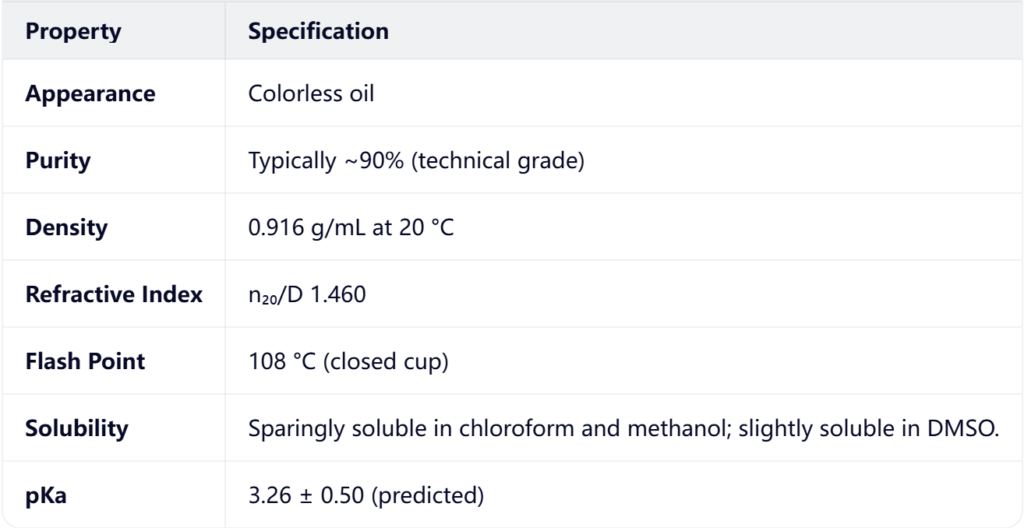
⚗️ Propriétés physiques et chimiques
Le tableau suivant résume les principales propriétés physiques et chimiques du Bis(2,4,4-triméthylpentyle)acide phosphinique.
🧪 Candidatures
Bis(2,4,4-triméthylpentyle)l'acide phosphinique est un réactif polyvalent utilisé dans divers domaines spécialisés:
Extraction de solvant: Il est largement utilisé comme extractant acide pour la séparation et la récupération des ions métalliques., comme l'Indium(III) et autres métaux divalents (Par exemple, Zn²⁺, Cu²⁺, Pb²⁺).
Synthèse de nanomatériaux: Il sert de ligand de passivation de surface dans la synthèse de “taille magique” nanocristaux, comme le CdSe et le CdTe.
Extraction de fluide supercritique (SFE): Le composé agit comme un ligand acide pour faciliter l'extraction des métaux de matrices comme le sable et les cendres volantes à l'aide de CO₂ supercritique..
⚠️ Sécurité et Manipulation
Lors de la manipulation de ce produit chimique, il est crucial de suivre les protocoles de sécurité appropriés.
Classification des risques: Il est classé comme irritant pour les yeux (Catégorie 2).
Mention de danger: Provoque une grave irritation des yeux (H319).
Conseils de prudence:
Porter des gants de protection et une protection des yeux/du visage.
SI DANS LES YEUX: Rincer délicatement à l'eau pendant plusieurs minutes. Retirer les lentilles de contact, si présent et facile à faire. Continuer à rincer.
Stockage: Conserver à température ambiante dans un récipient fermé. Il est considéré comme un liquide combustible.
Nos extracteurs de métaux comme ci-dessous, Si vous avez besoin d'une sorte, s'il vous plaît demandez-nous:
- P204 (D2EHPA ou HDEHP) Ceci est utilisé comme première étape pour éliminer les impuretés du minerai de nickel latéritique.
- DY319 extracteur de co-extraction de nickel et de cobalt à haute efficacité pour le recyclage des batteries, peut extraire le nickel et le cobalt ensemble de l'électrolyte de la batterie au lithium.
- DY272 Extracteur de séparation nickel-cobalt, il peut extraire le cobalt de la solution de nickel-cobalt, puis laisse du nickel pur.
- DY988N/DY973N/DY902/DY5640 réactif d'extraction par solvant du cuivre.
- P507 extracteur de métaux non ferreux pour le cuivre, zinc, cobalt-nickel, cadmium, or, argent, métaux du groupe du platine, terres rares et ainsi de suite.
- DY377 Extracteur efficace de séparation du nickel et du diamant.
- DY366 Extracteur de scandium.
- DY316 Extracteur de lithium.
- DY-SS-01 extracteur de fer, calcium, cadmium et scandium à différentes valeurs de pH.