 English
 العربية
 azərbaycan dili
 বাংলা
বাংলা Français
 Deutsch
 Indonesia
 한국어
한국어 Melayu
 پارسی
پارسی Polski
 Português
 Română
 Русский
 Español
 Kiswahili
 ภาษาไทย
 Türkçe
 Українська
 اردو
اردو Tiếng Việt
Extracting cobalt from copper-cobalt alloys and cobalt-containing waste is a complex but important metallurgical process. The following is a detailed analysis of the process:
1. Cobalt resources and distribution
The world’s cobalt resources are relatively abundant, and cobalt reserves are concentrated in Congo (DRC), Australia, Cuba, Zambia, New Caledonia, Russia and Canada, accounting for more than 95% of the world’s total reserves.
2. Copper-cobalt alloys and cobalt-containing waste
There are two main types of copper-cobalt alloys: one is the alloy obtained by converting the converter slag obtained by converter blowing during copper smelting, and then reducing it in an electric furnace, smelting and quenching it with water; the other is the alloy produced by reducing cobalt oxide ore with coke in an electric furnace.
There are many types of cobalt-containing waste, which generally contain valuable metals such as copper, zinc, manganese, nickel, and cadmium.
3. Methods for extracting cobalt
Acid leaching
Principle: Sulfuric acid, nitric acid, and hydrochloric acid can all be used to transfer the metal in the cobalt alloy into the solution. When oxygen is present, metallic copper and other active metals react with acid to form metal ions and enter the solution.
Conditions: When the initial concentration of sulfuric acid is 6 mol/L, the leaching temperature is 100℃, the leaching time is 6h, and the liquid-solid volume mass ratio is 5:1, the leaching rates of cobalt and nickel reach 95.37% and 96.73% respectively.
Features: The leaching rate of cobalt can reach about 95%, but it cannot be further improved.
Microbial leaching method
Principle: Use certain microorganisms or their metabolites to oxidize, reduce, dissolve, adsorb, etc. certain minerals to transfer cobalt into the solution.
Features: Suitable for treating lean ores, tailings, slag, etc., with low investment, high metal extraction rate, and no pollution.
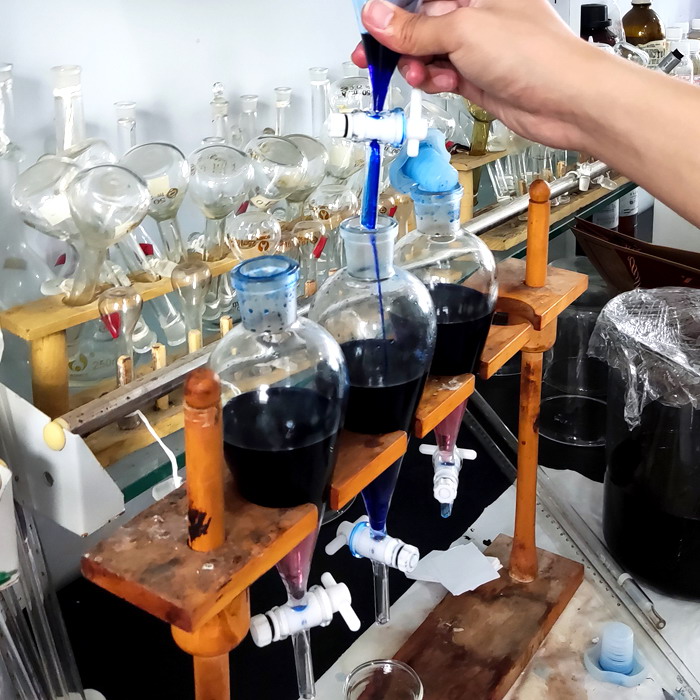
Solvent extraction method
Principle: Use the extractant to selectively extract cobalt to achieve the separation of cobalt from other metals.
Extractant: Phosphine extractants such as P204, P507, 5709, as well as pyridine carboxylic acid esters and alkyl pyridines.
Features: It has the advantages of high selectivity, high direct recovery rate, simple process, continuous operation, and easy automation. It has become the main method for extracting cobalt.
IV. Other considerations
During the extraction process, attention should be paid to the leaching rate, recovery rate and production cost of cobalt.
For different types of copper-cobalt alloys and cobalt-containing waste, appropriate extraction methods and process parameters should be selected.
Our metal extractants as below:
- P204 (D2EHPA or HDEHP) This is used for first step to remove impurity for laterite nickel ore.
- DY319 high efficiency nickel cobalt co-extraction extractant for battery recycle, can take out nickel and cobalt together from Lithium battery electrolyte.
- DY272 Nickel cobalt separation extractant, it can take cobalt out from nickel cobalt solution, then leave pure nickel.
- DY988N/DY973N/DY902/DY5640 copper solvent extraction reagent.
- P507 non-ferrous metal extractant for copper, zinc, cobalt-nickel, cadmium, gold-silver, platinum group metals, rare earths and so on.
- DY377 efficient nickel and diamond separation extractant.
- DY366 Scandium extractant.
- DY316 Lithium extractant.